15 min read  •  11 min listen

Small & Fast

How the Strangest Physics Runs Your Everyday World

Small & Fast

AI-Generated

April 28, 2025

You already live in a world built by the weirdest ideas in physics. From your phone’s GPS to the lights in your room, the tiniest and fastest things in the universe are working behind the scenes. Get ready to see how the rules of the very small and the very fast are hiding in plain sight, shaping your everyday life in ways you never imagined.


Time Gets Weird: Relativity in Your Pocket

A calm commuter at a futuristic bus stop checks a glowing watch while near-light-speed vehicles leave colorful light trails.

You sit quietly, cars blur past, and time feels solid. Relativity says otherwise. A traveler racing by almost at light speed experiences each second more slowly than you do.

Why Time Isn’t Always the Same

A 1970s researcher studies an airborne atomic clock inside a retro airplane cockpit, Earth curving beyond the window.

In 1971 scientists flew atomic clocks around the world and compared them with identical ones left on the ground. The airborne clocks drifted exactly as Einstein predicted. Speed also squeezes length and boosts mass, but only at near-light velocities, so everyday runners miss the show.

A hand holds a smartphone in front of a night skyline while bright beams link the screen to orbiting GPS satellites.

Satellites and the Race Against Time

GPS satellites circle Earth at roughly 14 000 km/h. Their motion slows each satellite’s clock by about 7 microseconds daily. That tiny lag would place you kilometers off course if left uncorrected.
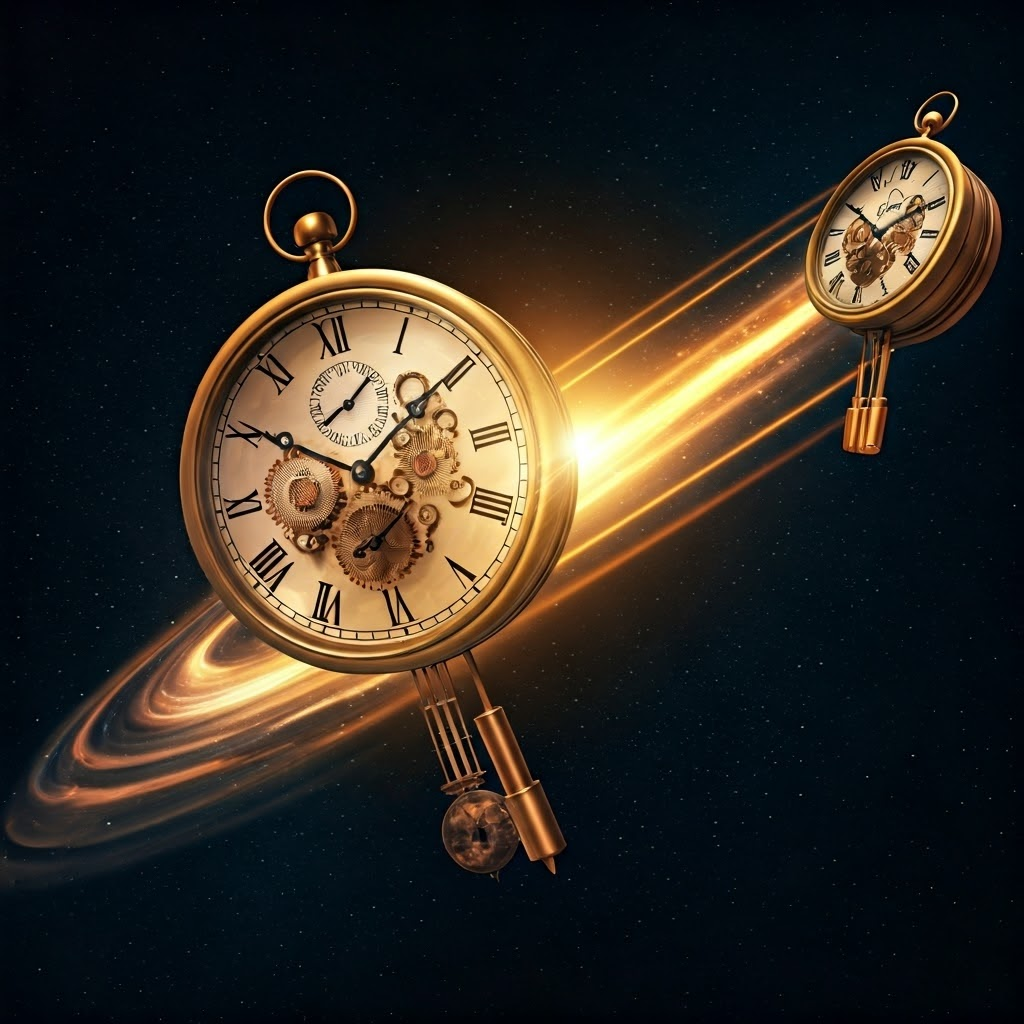
Two ornate brass clocks float in space—one near Earth’s gravity well, one farther out—highlighting microsecond differences.

Weaker gravity in orbit speeds those clocks up by roughly 45 microseconds each day. The net shift is 38 microseconds. Engineers pre-tune satellite timers on the ground, applying formulas like Δt=γt\Delta t = \gamma tΔt=γt, so your map lines up with your café door.

A split scene shows a nuclear plant and the blazing Sun linked by streams of released energy while a doctor holds a vivid PET scan.

Mass, Energy, and the Power in Your Pocket

Einstein’s E=mc2E = mc^2E=mc2 states that mass and energy are interchangeable. A tiny bit of mass fuels nuclear reactors, lights the Sun, and powers medical PET scans where particles annihilate inside you to reveal hidden anatomy.

A kitchen smoke detector with a discreet radiation symbol glows softly while microscopic particles drift nearby.

Even home smoke detectors rely on a speck of radioactive material converting mass to energy. Einstein’s numbers left the chalkboard long ago—they now patrol your ceiling.

A young Einstein dashes down a cobblestone street chasing a radiant beam of light amid amazed bystanders.

Einstein’s Leap and the Sci-Fi Trap

Einstein pictured chasing light and realized its speed stays fixed for all observers. That simple insight rewrote space and time. He published special relativity in 1905 without inventing new forces—he just saw old laws from a fresh angle.

An astronaut in low Earth orbit checks a wristwatch, neon trails of stars curving behind a retro rocket.

Films glamorize time jumps, yet real astronauts age only microseconds slower than us. Relativity hides in everyday tech, quietly aligning videos, rides, and calls so life stays in sync.

A pastel collage layers a smartphone map, jetliner, PET scanner, power plant, and café scene into one serene composition.

The Real Life of Relativity

Relativity works inside phones, planes, hospitals, and power stations. The next time GPS pins you to a table at your favorite café, remember the weirdness of time overhead keeps your meetup from wandering off course.


Tome Genius

Physics in Everyday Life

Part 10

Tome Genius

Cookie Consent Preference Center

When you visit any of our websites, it may store or retrieve information on your browser, mostly in the form of cookies. This information might be about you, your preferences, or your device and is mostly used to make the site work as you expect it to. The information does not usually directly identify you, but it can give you a more personalized experience. Because we respect your right to privacy, you can choose not to allow some types of cookies. Click on the different category headings to find out more and manage your preferences. Please note, blocking some types of cookies may impact your experience of the site and the services we are able to offer. Privacy Policy.
Manage consent preferences
Strictly necessary cookies
Performance cookies
Functional cookies
Targeting cookies

By clicking “Accept all cookies”, you agree Tome Genius can store cookies on your device and disclose information in accordance with our Privacy Policy.

00:00