

Meet Your Robot’s Senses: The Basics and Beyond
Sensing is vital whether you are human or machine. Try walking with closed eyes, you quickly feel lost. Robots rely on sensors built from metal, silicon, and clever code to avoid that confusion.
There are two broad kinds: proprioceptive and exteroceptive. Proprioceptive devices report the robot’s own state, while exteroceptive units describe the outside world.
A wheel encoder illustrates proprioception. It counts each rotation so the robot can estimate distance covered and speed.
A camera stands for exteroception. It captures light, letting software spot doors, chairs, or stairs, then plan safe moves.
Robots need both streams. Without internal data they forget where limbs are. Without external data they collide with the environment, upsetting their balance.
The Usual Suspects: Common Sensors in Action
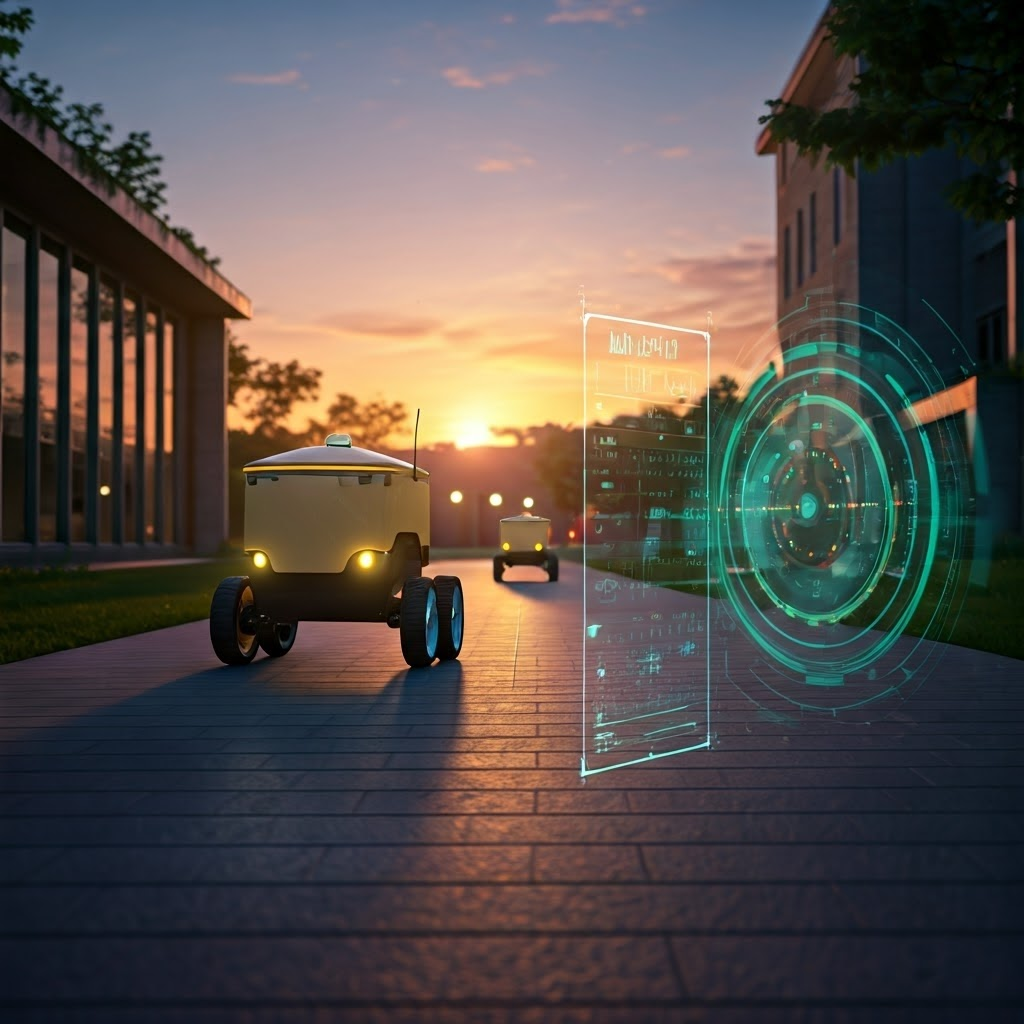
The humble encoder attaches to a wheel or joint and ticks like a pedometer. Campus delivery robots depend on it to measure every distance.
An IMU combines gyroscopes and accelerometers. It senses tilt and acceleration, helping drones stay level and two-wheeled bots avoid tipping.

A force-torque sensor gives robots a sense of touch. Fitted in arms or grippers, it measures push, pull, and twist so glassware arrives intact.
Vision systems dominate modern machines. Vacuums map rooms, cars spot pedestrians, and software turns pixels into labeled objects.
LiDAR fires laser pulses, times the echoes, and builds a 3-D map that works day or night. It is precise and long-range.

Sonar swaps light for sound. Underwater vehicles favor it because sound travels farther in water. Some vacuums also ping soft curtains no camera sees.
Structured-light and time-of-flight depth sensors create dense point clouds. The Xbox Kinect popularized the idea for hobbyists and helps robots navigate crowds.

Analog vs. Digital: Speaking Robot
After sensing, data travels to the robot’s brain. Each signal arrives as analog or digital.
Analog outputs vary smoothly, like a lamp dimmer. A temperature probe might slide from 0 V to 5 V as heat rises.
Digital outputs jump between discrete levels or send exact numbers, like a light switch or a serial packet.
When a computer needs analog data, an ADC steps in and samples the voltage.

Raw measurements carry noise. Signal filtering amplifies weak readings, removes static, and shifts voltages into safe ranges before processing.
A robot’s performance relies on this hidden sensor team. Together they let machines see, feel, and move with assurance.
