Waves Everywhere: From Surf to Signals
Drop a pebble into a quiet pond and rings glide outward while the water hardly shifts. Energy moves on, yet the water itself only bobs in place.
Tug one end of a jump rope and a bump races to the other side. The rope hardly drifts sideways, but the same energy travels along its length.

A wave is a repeating disturbance that transports energy without hauling material. Whether you watch surfers, a flag fluttering, or music thumping in your chest, you witness energy on the move—not matter.

Transverse and Longitudinal: The Two Main Flavors
In a transverse wave, the wiggle sits at right angles to the travel direction. Pluck a guitar string or watch ocean swells—the medium moves up or down while the wave pushes forward.

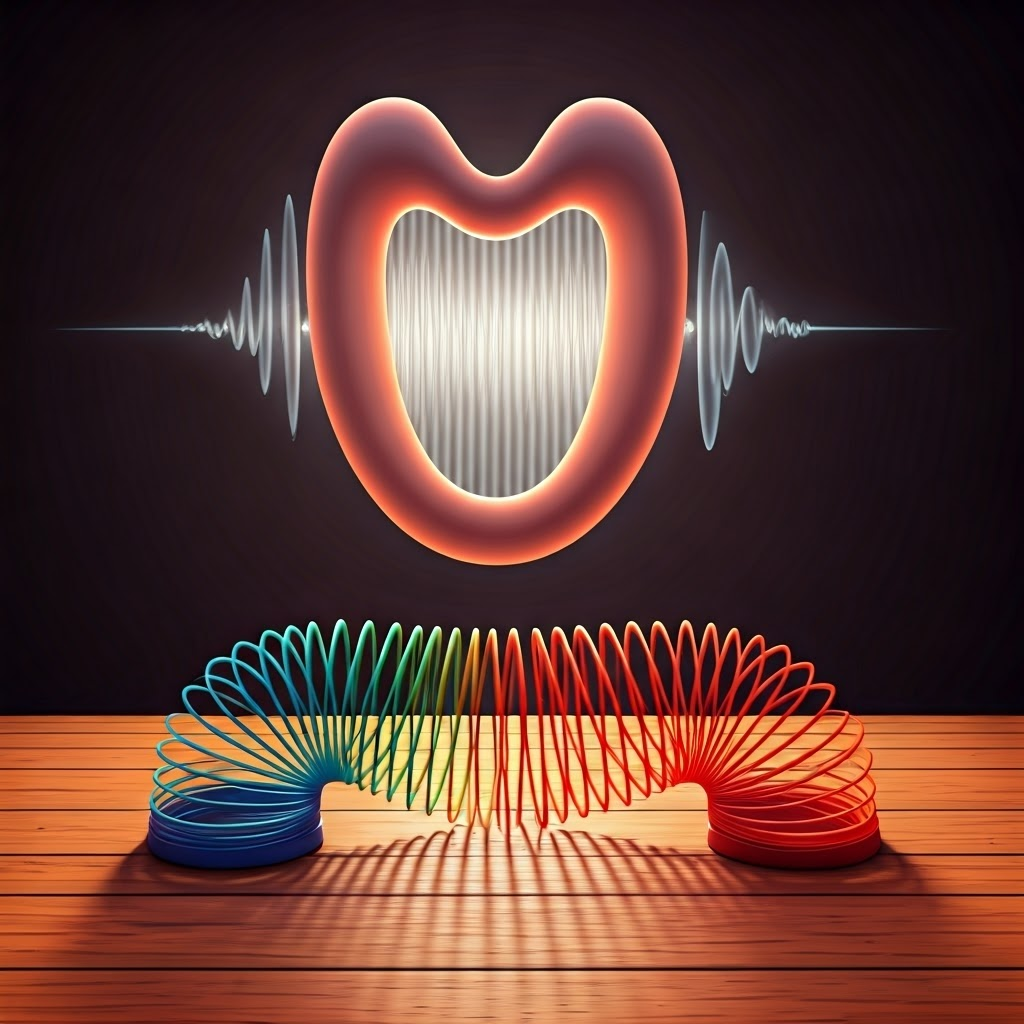
A longitudinal wave squashes and stretches along its path. Push and pull a slinky and you see compressions slide along the coils. Sound works this way; vibrating vocal cords press and relax air molecules toward a listener.
Some waves require a medium—like air or rope—while light does not and can cross empty space.
Wavelength, Frequency, Speed, and Amplitude: The Four Key Ingredients
Wavelength measures one full cycle—the span from crest to crest or squish to squish.
Frequency counts how many complete waves pass each second, noted in hertz. Higher frequency means higher musical pitch.

Amplitude marks how tall a wave stands from its midpoint. Bigger amplitude equals louder sound or taller surf.
Every wave owns a speed—how fast the pattern moves through its medium. Sound races through air near 1,230 km/h, while light in a vacuum hits about 300,000 km/s.
The simple rule ties them together:
Know any two values and you can solve for the third. Shorter wavelength at the same speed demands higher frequency, explaining light’s colors and a piccolo’s sharp tone.
Waves in Your World
Pressure waves craft the music in your earbuds as your ears turn air vibrations into signals. Your phone chats with towers through electromagnetic waves that tweak frequency and amplitude to carry data.

Seismic waves shake the ground during quakes. Sunlight splits into a rainbow through droplets because different frequencies bend by different amounts.
At home, pluck a ruler, tap a glass, or observe puddle ripples. The same principles create a stadium crowd wave, road heat shimmer, and your Wi-Fi link.
Realizing that a bass drum’s thud, a butterfly’s shimmer, a 5G call, and crashing surf all share one idea—waves moving energy—can be mind-opening.