16 min read  •  9 min listen

Observing the Invisible

How Quantum Measurement Changes What You See (and What You Think You See)

Observing the Invisible

AI-Generated

April 28, 2025

You think you know what it means to see something? Think again. This tome takes you on a journey through the strange world of quantum measurement, where the act of looking changes everything. Get ready to question what it means to observe, and discover how the invisible becomes real—if only for a moment.


The Quantum Curtain: What Happens When You Look?

Scientist studies a glowing, probability-shaped electron cloud through a high-tech viewport, symbolizing how observation affects quantum outcomes.

Observation in quantum physics feels like lifting a hidden curtain. A glance doesn’t just reveal reality—it creates the specific outcome you see.

The Measurement Postulate: The Rules of the Game

Every quantum system lives inside a wave function. This function is a probability map, not a picture. Thick regions hint at higher chances of finding, say, an electron; thin regions mark low odds.

Hand draws a glowing card from a deck of light, capturing the randomness of quantum results.

A measurement returns one clear answer—yet before the act, the particle is spread everywhere. The Born rule tells us to square the wave function’s size to get each result’s chance.
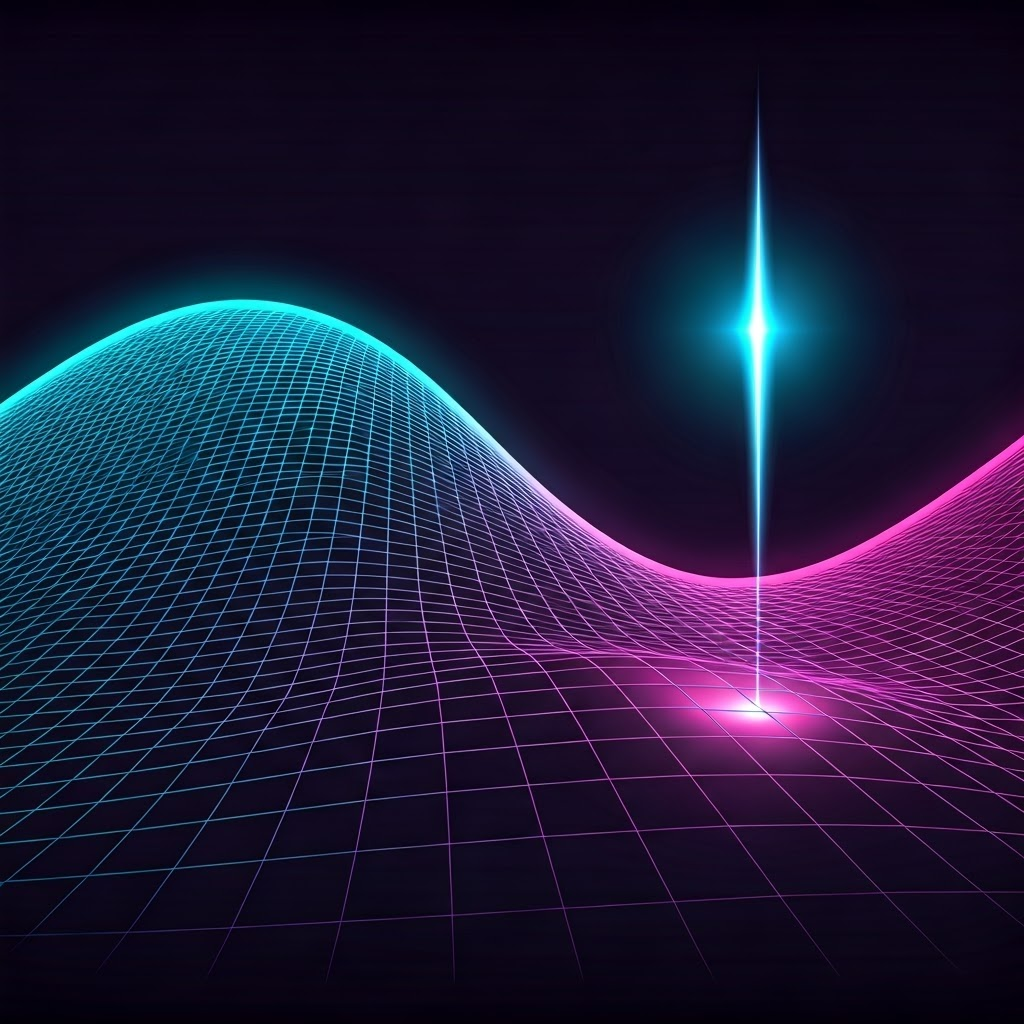
Graphic wave collapses into a single bright point, showing the sudden selection of one result.

Wave-Function Collapse: The Big Jump

During a measurement, the wave function collapses. A smeared-out electron snaps to one location, a switch unlike any smooth classical motion.

Schrödinger’s cat appears half-ghostly, half-solid inside a translucent box, dramatizing quantum superposition.

Schrödinger’s cat captures the idea: until you open the box, the cat is both alive and dead. Looking forces one reality to emerge.

Glowing quantum particle unravels into colorful swirls, hinting at environmental influence.

Decoherence: The Quiet Fade

Decoherence offers a gentler story. Interaction with the environment scrambles delicate quantum patterns, washing out superpositions without an abrupt jump.
Central orb dims into glitchy ripples, symbolizing quantum states blending with surroundings.

Collapse is a flip of a switch; decoherence is a slow dimmer. Real-world systems decohere so fast that only one outcome remains visible.

Why the Curtain Matters

Person pulls a neon holographic curtain to reveal cosmic waves, echoing how measurement shapes reality.

Looking doesn’t merely uncover facts—it changes them. Understanding collapse and decoherence guides experiments, informs quantum tech, and reminds us that reality depends on how, and whether, we choose to look.


Tome Genius

Quantum Mechanics Unveiled

Part 6

Tome Genius

Cookie Consent Preference Center

When you visit any of our websites, it may store or retrieve information on your browser, mostly in the form of cookies. This information might be about you, your preferences, or your device and is mostly used to make the site work as you expect it to. The information does not usually directly identify you, but it can give you a more personalized experience. Because we respect your right to privacy, you can choose not to allow some types of cookies. Click on the different category headings to find out more and manage your preferences. Please note, blocking some types of cookies may impact your experience of the site and the services we are able to offer. Privacy Policy.
Manage consent preferences
Strictly necessary cookies
Performance cookies
Functional cookies
Targeting cookies

By clicking “Accept all cookies”, you agree Tome Genius can store cookies on your device and disclose information in accordance with our Privacy Policy.

00:00