18 min read  •  13 min listen

Hello from Earth

How We Really Talk to Spacecraft (and Get a Reply)

Hello from Earth

AI-Generated

April 28, 2025

Ever wondered how we send a message to a robot millions of miles away—and actually get a reply? This tome takes you behind the scenes of space communication, showing you the clever tricks, tools, and teamwork that make it all possible. Get ready to see how Earth says hello to the stars.


The First Ping: Making Contact Across the Void

An astronaut in a reflective helmet releases swirling blue radio waves toward a distant planet, illustrating the challenge of space communication.

Space is silent. Outside a spacecraft your shout would die instantly because nothing vibrates in the vacuum. To bridge that emptiness we beam radio waves—an invisible form of light—that slowly fade as they cross the void.

Why Space is So Quiet

A small golden probe drifts beyond an icy planet while faint signal arcs reach a massive Earth dish, capturing the fragility of deep-space pings.

A spacecraft’s message arrives unbelievably faint. Voyager 1’s weekly ping carries less power than a falling snowflake. Giant dishes and sensitive electronics still decode that whisper. The clear vacuum helps, yet vast distance weakens energy. Distance doubles—signal strength quarters—so every part of the system must excel.

A dimly lit spacecraft cockpit shows radio spectra peaks while colored data beams stream into starry space, hinting at precise frequency control.

How We Use Radio Waves to Talk to Spacecraft

Radio waves are light with lower energy than what our eyes see. They move easily through vacuum and mostly through Earth’s air. We tweak their frequency to match each mission’s needs, balancing range, data rate, and reliability.

Neon lanes labeled with frequency bands carry tiny spacecraft past glitchy static, visualizing the choice of communication channels.

Choosing a frequency band feels like picking the right highway lane. X-band, around 8–12 GHz, offers a steady compromise of speed and strength. Ka-band, near 26–40 GHz, moves data faster but demands perfect pointing and clear weather.
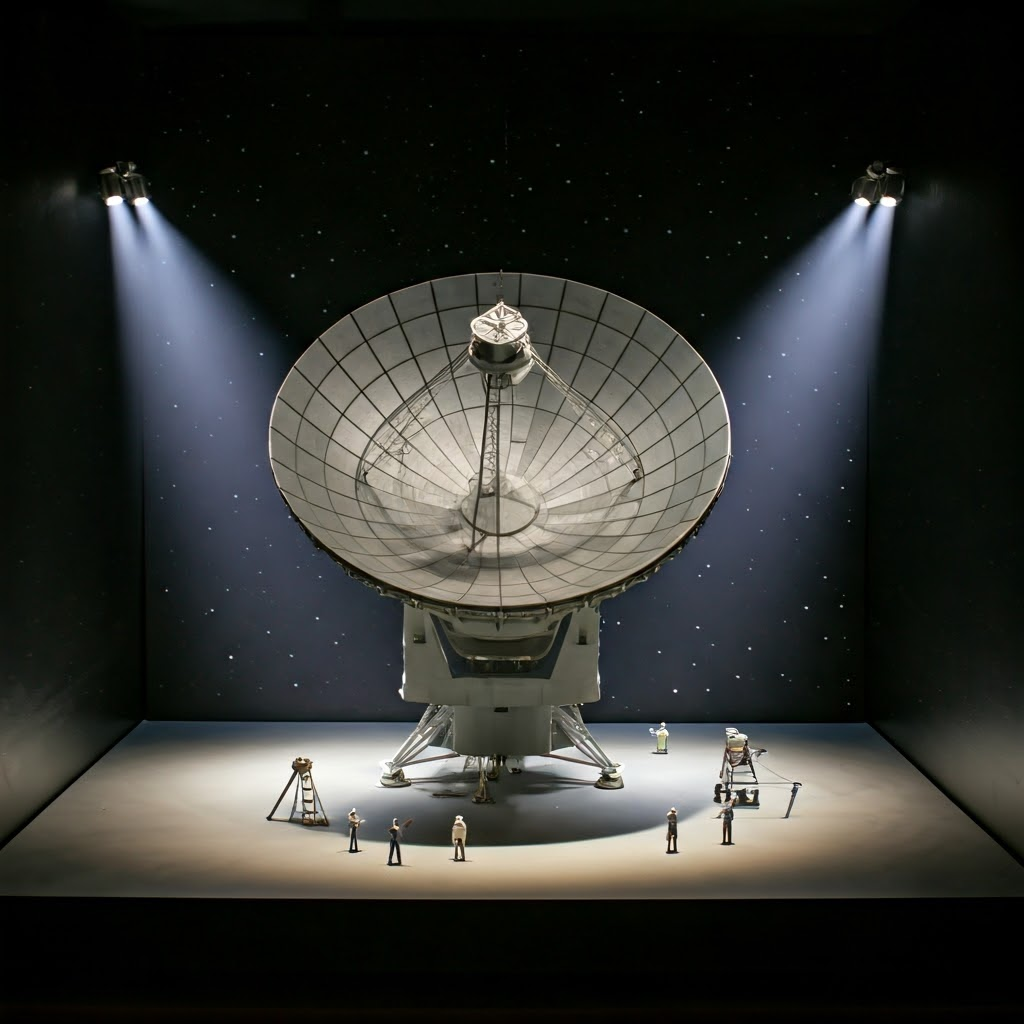
A detailed model of a giant Deep Space Network dish towers over miniature engineers, underscoring its massive scale and precision.

Antennas: The Ears and Mouths of Space Missions

An antenna focuses weak signals much like a magnifying glass gathers sunlight. Bigger dishes capture more energy, so NASA’s Deep Space Network uses reflectors up to 70 meters wide in California, Spain, and Australia.

Spacecraft carry two main antennas. A high-gain dish delivers narrow, data-rich beams but needs precise aim. A low-gain backup sprays signals in all directions—slow yet hard to miss.

A robotic hand and a gloved human hand almost touch while sharing a glowing pulse, symbolizing successful deep-space contact.

Picking the Right Tools Means Making Contact Possible

Each exchanged message is a small engineering wonder. A faint whisper rides a chosen frequency, leaves a well-aimed antenna, and meets Earth’s largest electronic ears. Catching that first ping shrinks the solar system for a heartbeat—and proves we can say hello across the void.


Tome Genius

Space Missions & Engineering

Part 7

Tome Genius

Cookie Consent Preference Center

When you visit any of our websites, it may store or retrieve information on your browser, mostly in the form of cookies. This information might be about you, your preferences, or your device and is mostly used to make the site work as you expect it to. The information does not usually directly identify you, but it can give you a more personalized experience. Because we respect your right to privacy, you can choose not to allow some types of cookies. Click on the different category headings to find out more and manage your preferences. Please note, blocking some types of cookies may impact your experience of the site and the services we are able to offer. Privacy Policy.
Manage consent preferences
Strictly necessary cookies
Performance cookies
Functional cookies
Targeting cookies

By clicking “Accept all cookies”, you agree Tome Genius can store cookies on your device and disclose information in accordance with our Privacy Policy.

00:00