17 min read  •  12 min listen

Data Fusion Basics

How Robots Turn Noisy Data Into Something You Can Trust

Data Fusion Basics

AI-Generated

April 28, 2025

Ever wondered how robots make sense of a noisy, confusing world? Peek behind the curtain and see how simple math and clever tricks turn messy sensor data into something you can trust. If you want to know how robots really know where they are, this is for you.


Making Sense of Messy Signals

Service robot peers through a rain-dotted window, symbolizing how robots view the world through imperfect, noisy data.

Sensors act like a robot’s eyes and ears, yet they never deliver a flawless view. Each reading carries noise, the random static that blurs reality.

Why Sensor Data is Never Perfect

Hand holds a kitchen thermometer while sunlight and appliance hum add interference, representing everyday noise sources.

Noise shows up everywhere. A shaky hand, bright glare, or radio buzz slips into measurements. Even identical sensors disagree, so trusting every value would leave a robot jumpy or lost.

Thermometer in direct sun reads too hot while GPS graphic jumps, showing bias and outliers.

Sensors also add bias. A sun-baked thermometer reads high, a thick glass one reacts slowly, and a GPS may jump to the ocean for a moment. Spotting these oddballs matters before the data guides decisions.

Robotic paintbrush smooths numbers on a wall, illustrating removal of bad readings.

Cleaning Up the Mess: Filtering and Normalization

If raw readings are foggy, you must clean them. One step is tossing out wild outliers—like ignoring a sudden 50 °C spike among steady 22 °C readings.

Cartoon scale flicks away an outlier weight, showing simple outlier rejection.

A quick rule helps: if a value strays far from recent ones, discard it. Even basic outlier rejection steadies results.

Split screen of jagged versus smoothed signals, sliders adjust a moving average.

Next comes filtering. A moving average blends the latest few readings, reducing small jitters and giving a calmer signal.

Dashboard converts varied sensor units into a unified 0-1 scale for easy fusion.

Different sensors often speak in mismatched units. Normalization converts everything to a common scale, preventing mix-ups like Celsius versus Fahrenheit.

Stained glass shows waves passing through a gate labeled Low-Pass, visualizing filter types.

Meet the Filters: Low-Pass, High-Pass, and Band-Pass

A low-pass filter lets slow trends through and blocks rapid spikes. Software often uses the formula y[n]=αx[n]+(1−α)y[n−1]y[n]=\alpha x[n]+(1-\alpha)y[n-1]y[n]=αx[n]+(1−α)y[n−1] where (\alpha) sets the blend.

Glass of water splashes from a bump, illustrating high-pass focus on sudden change.

A high-pass filter keeps sharp changes and dismisses slow drifts, handy for spotting jolts or clicks.

ECG graphic shows heartbeat passing a filter mesh, blocking drift and static.

A band-pass filter narrows focus further—only a chosen frequency band slips through, perfect for isolating a heartbeat in noisy data.

All filters share one idea: keep what matters, ignore the rest. Yet too much filtering hides real events, while too little leaves clutter. Tuning is part science, part art.
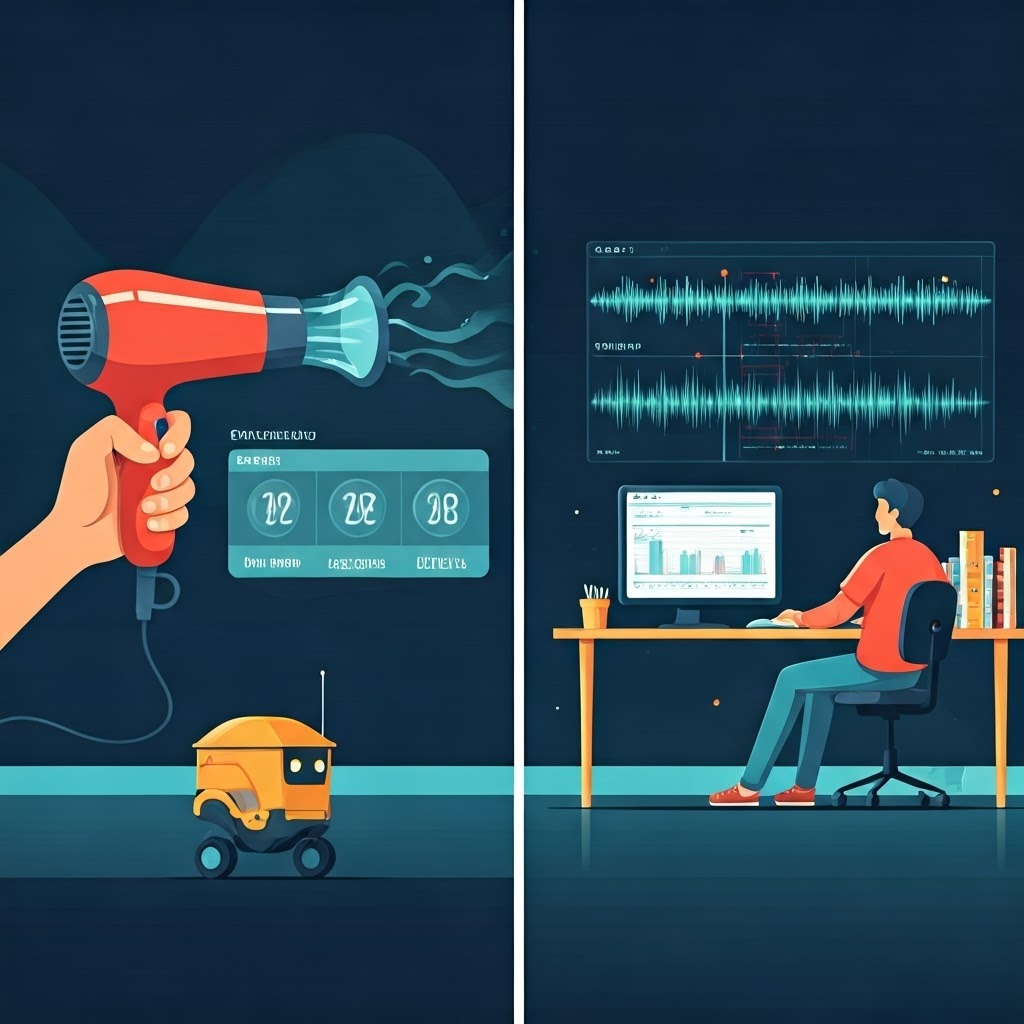
Split scene: hair dryer heats thermometer, editor applies filters, delivery robot rolls by.

In Practice

Wave a hair dryer near a thermometer and watch numbers spike then settle—that calm phase mirrors a filter’s work. Audio editors show the same effect when you apply low-pass or high-pass tools.

Think of a sidewalk delivery robot. Its sensors catch bus roars, dog barks, and steady foot traffic. Good preprocessing—outlier rejection, filtering, and normalization—turns chaos into reliable data. Without it, even clever algorithms fall for every gust of wind.


Tome Genius

Robotics: Design & Control Systems

Part 4

Tome Genius

Cookie Consent Preference Center

When you visit any of our websites, it may store or retrieve information on your browser, mostly in the form of cookies. This information might be about you, your preferences, or your device and is mostly used to make the site work as you expect it to. The information does not usually directly identify you, but it can give you a more personalized experience. Because we respect your right to privacy, you can choose not to allow some types of cookies. Click on the different category headings to find out more and manage your preferences. Please note, blocking some types of cookies may impact your experience of the site and the services we are able to offer. Privacy Policy.
Manage consent preferences
Strictly necessary cookies
Performance cookies
Functional cookies
Targeting cookies

By clicking “Accept all cookies”, you agree Tome Genius can store cookies on your device and disclose information in accordance with our Privacy Policy.

00:00