The Dawn of Reason
Setting the Stage
Imagine yourself in ancient Athens, strolling through sunny streets, hearing lively debates echoing from open squares. People gather around, asking questions you might still wonder about: what's real, what's true, and what's right.
They were deeply curious. Greek thinkers weren't satisfied with superstition alone—they wanted clearer methods. This choice to value reason and testable ideas sparked something powerful: the careful search for truth we call reason.
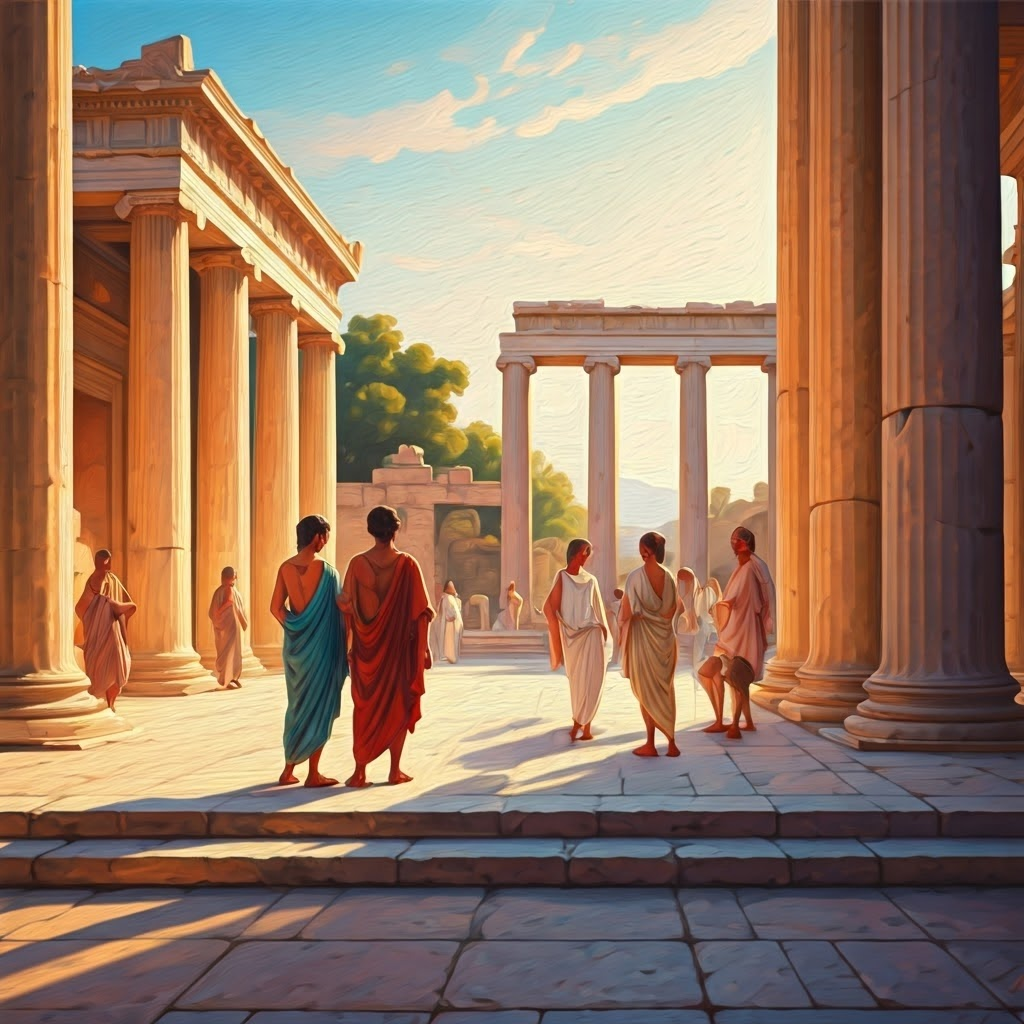
Before Plato and Aristotle, people relied on stories or myths to explain the world. But myths can clash, and stories contradict. The solution was to talk it out, using reason and sharper language. Greeks loved a good debate; they knew conversations were vital for learning.
They saw that ideas must be clear enough to share, test, or even disprove. That insight—knowledge grows through open discussion—shaped centuries of discovery. It still influences how we learn today.
Logic Through the Eyes of Plato and Aristotle
Plato believed truth lived in perfect, unchanging forms. The world around you isn’t fully real because everyday objects can break or fade. He argued that ideas—like the concept of a chair—are more lasting than the physical chair itself.
He taught us not to trust the senses alone. Instead, pair them with reason. Aristotle, his student, disagreed slightly. He saw truth right here in nature. He believed in keen observation and logical thought to find it.
Aristotle introduced the syllogism, a tool to test ideas. For instance: all humans are mortal, Socrates is human, so Socrates is mortal. This pattern, where two premises lead to a conclusion, powers logical thinking. Aristotle believed it uncovered truths in fields from astronomy to politics.

How Logic Lives Today
You use logic daily without noticing. When your phone won't turn on, you reason that the battery might be dead and decide to charge it. You've identified a problem, used logic, and tested a fix—exactly what those ancient thinkers wanted.

Early philosophers had flaws in some conclusions, yet their deeper insight—that reason leads you closer to truth—forms the backbone of modern thought. Scientists run experiments, historians analyze evidence, and both rely on the same logical steps the Greeks outlined.
Greek wisdom also shaped moral thought. Plato asked what makes something good. Aristotle wondered how to live well. He saw virtue as balance: courage stands between recklessness and cowardice. That's reason at work when you treat others fairly today.
Their questions still matter. That's why these ideas haven't faded. Anyone who asks “why?” joins a conversation started thousands of years ago. Plato and Aristotle shared the radical belief that truth improves with careful reasoning and open debate. You're still part of that conversation today.